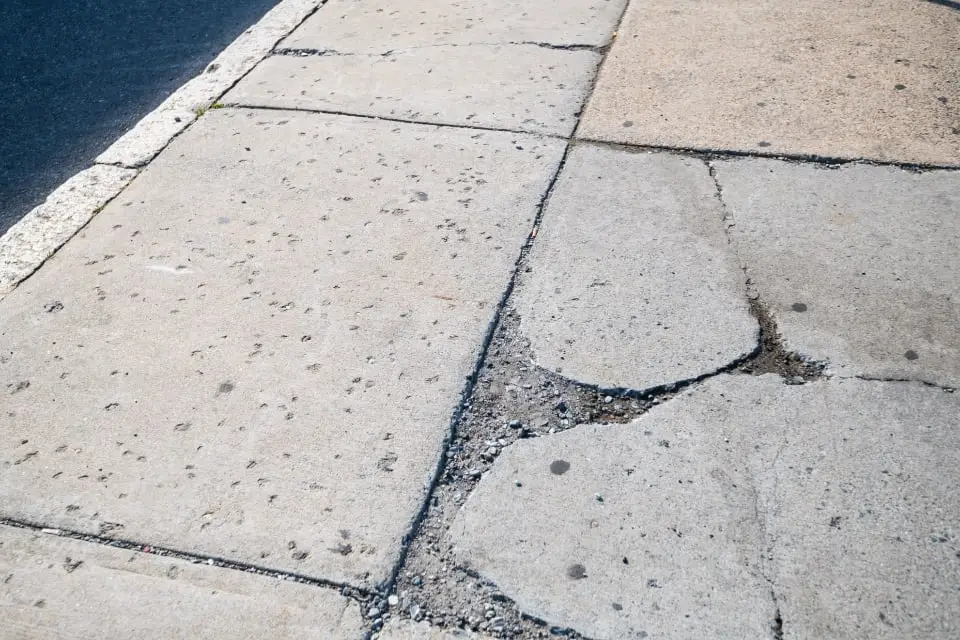
When concrete starts cracking, sinking or flaking, the decision usually comes down to one question: is the slab still well supported and basically sound, or has it lost support underneath? Repairs work well on the first kind of problem. On the second, patching treats the symptoms while the cause keeps working.
The short answer
- Repair tends to make sense when damage is limited, stable and on the surface, and the concrete around it is sound.
- Replacement tends to make sense when damage is widespread, recurring or structural, especially when panels have moved or the base has failed.
- An on-site assessment is what settles it, because the same crack can mean different things depending on what’s underneath.
Start by finding the cause
Before comparing prices, figure out why the concrete is failing. The most common causes:
- Shrinkage. Concrete shrinks as it cures, and some cracking is normal. Control joints are meant to guide it. Hairline cracks between joints are common and usually cosmetic.
- Settlement. Soil under the slab compresses, erodes or was never compacted well, so part of the slab loses support. Look for cracks with one side lower and panels that tilt.
- Water. Downspouts, irrigation, poor grading or cracks let water soften the base. In winter it freezes and expands.
- Freeze-thaw and deicers. Scaling, pop-outs and crumbling at the surface, common on Utah driveways and walks. See concrete and Utah weather.
- Overloading. Vehicles on concrete built for foot traffic, or heavy trucks on a standard driveway.
- Tree roots. Roots lifting and breaking panels, especially along older sidewalks.
- Original construction. A thin slab, missing reinforcement, poor joint layout or a rushed cure.
Surface causes can often be repaired. Support and drainage causes usually need to be corrected, and that often means removing concrete to get at them.
When repair usually makes sense
- A few isolated cracks in slabs that are still level and aren’t getting wider.
- Light surface scaling in limited areas, on concrete that’s otherwise sound.
- Chipped edges or corners on steps and slab edges.
- Open joints that need resealing, such as the gap where a driveway meets the garage slab.
- A single panel that settled slightly and is still in one piece, which may be a candidate for slab lifting.
Well-executed repairs keep water out, reduce trip hazards and can add years of service. See concrete repair for what’s typically involved.
When replacement usually makes sense
- Widespread cracking across much of the surface, especially cracks that break panels into several pieces.
- Significant heaving or settlement, with trip edges or water now draining toward the house.
- Scaling or crumbling over large areas, not just a few spots.
- Repeat failures, where the same areas have been patched and failed again.
- Concrete that doesn’t fit its use, such as a thin driveway now carrying trucks or an RV.
- Planned changes in layout, size or grade that require rebuilding anyway.
Replacement is also an opportunity to fix the underlying problem: correcting the base, improving drainage, adjusting thickness and reinforcement, and laying out joints properly. See concrete replacement.
Symptom-by-symptom comparison
| What you see | Often repairable when… | Often points to replacement when… |
|---|---|---|
| Hairline cracks | They’re stable, and the slab is level | They’re multiplying across the whole surface |
| Wider cracks | They’re isolated and not growing | They widen every season or one side has dropped |
| Sunken panel | It’s in one piece and the cause is fixed | It’s broken up or the base keeps washing out |
| Heaved panel | Minor, and grinding or lifting resolves the edge | Roots or frost keep lifting it, or it’s cracked through |
| Surface scaling | Light and limited to small areas | Deep, widespread or exposing lots of aggregate |
| Crumbling edges | Small chips at corners | Edges breaking away along long stretches |
| Water pooling | A minor low spot | The slab slopes toward the house or garage |
This table is a starting point for a conversation, not a diagnosis. The same symptom can have different causes.
Middle-ground options
It isn’t always all or nothing.
- Partial replacement. Cut out and replace the worst panels between existing joints. This is common for walkways, driveways and sidewalks. Expect some color difference between old and new concrete.
- Slab lifting. Raise a settled panel by injecting material beneath it. It works best for intact panels where the cause of settlement has been addressed.
- Grinding. Small trip edges between panels can sometimes be ground down.
- Resurfacing overlays. Thin overlays can refresh the look of sound concrete with surface wear, but they don’t hold up on cracked or moving slabs.
- Crack sealing plus drainage fixes. Sometimes the most effective step is redirecting a downspout or regrading soil, combined with sealing the existing cracks.
Thinking about cost
Repair costs less today. Replacement costs more today but may cost less over time if repairs would keep failing. A useful way to compare:
- How long is the repair expected to last, and why?
- Will the underlying cause still be there after the repair?
- How much has already been spent patching this area?
- Would replacement solve a second problem, such as a driveway that’s too narrow or drains toward the house?
Ask for both options in writing when the choice isn’t obvious, including what each one does and doesn’t address.
What an on-site assessment should look at
A good assessment goes beyond the surface. Expect the person evaluating your concrete to:
- Check whether panels have moved, and in which direction.
- Look at drainage: slope, downspouts, irrigation and where water goes.
- Look for signs of voids or soft base, such as hollow-sounding areas or soil washing out at the edges.
- Evaluate the surface condition and the likely cause of scaling or spalling.
- Consider use and loads: what drives or sits on the slab now, and what will in the future.
- Explain whether repair addresses the cause, and what happens if it doesn’t.
If the concrete includes a public sidewalk, curb, gutter or driveway approach, ask about Centerville City requirements before work begins. Centerville City Public Works handles approach-related applications.
Next steps
Note where the damage is, how large the affected area is, whether it’s changed over the last year, and anything that might be contributing, such as a downspout or sprinkler. That information makes an assessment faster and more useful. When you’re ready, request a quote and a local concrete professional can take a look.