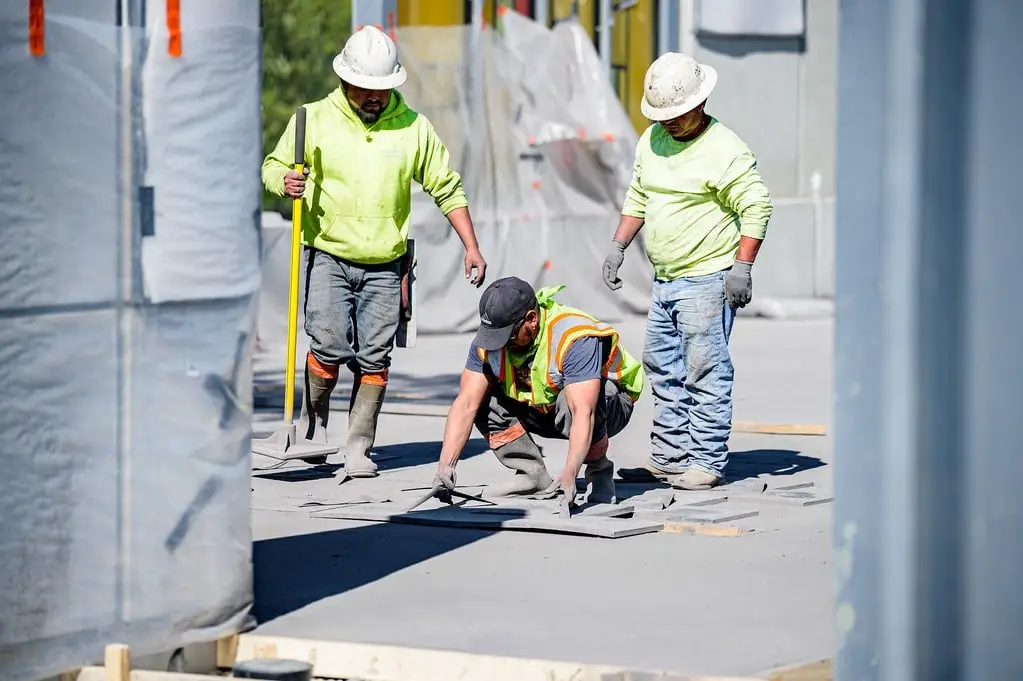
Commercial concrete has the same fundamentals as residential work, including base preparation, drainage, reinforcement and joints, plus a few extra layers: public safety, heavier loads, accessibility requirements and the need to keep a business running during construction. This page covers the flatwork most commonly needed by businesses, HOAs and property managers in Centerville.
What commercial concrete projects include
- Sidewalks and entries: replacing cracked or heaved panels, widening walks and rebuilding entries.
- Curb and gutter: repairing or replacing damaged sections along drives and parking areas.
- Dumpster enclosure pads and aprons: heavy-duty pads that stand up to refuse trucks.
- Equipment and utility pads: bases for HVAC units, generators and transformers.
- Loading areas and parking sections: concrete where asphalt fails under turning trucks or standing loads.
- Trip hazard repair: addressing lifted or broken panels before they become a liability.
Signs commercial concrete needs attention
- Lifted or sunken sidewalk panels that create trip edges near entrances.
- Crumbling concrete at dumpster pads where trucks set down and turn.
- Standing water at entries, curb lines or loading areas.
- Scaling and spalling from snowmelt and deicers at walkways and ramps.
- Curb damage from snowplows or vehicles.
Planning considerations for commercial work
Loads and design
Areas that carry refuse trucks, delivery vehicles or forklifts need thicker, more heavily reinforced concrete than residential flatwork, along with a base built for those loads. Larger or more complex projects may involve an engineer’s design and specifications.
Accessibility
Sidewalks, curb ramps and entrances at many commercial properties need to meet accessibility standards, which govern slopes, cross slopes and surface transitions. Plan for those requirements from the start, because rework is expensive.
Scheduling and phasing
Commercial clients often need to keep entrances open, maintain parking, and work around tenant or customer hours. Phasing the work, pouring in sections, and planning cure times around traffic are common strategies. Share your constraints early.
Safety and traffic control
Work near entrances, parking lots and streets requires barricades, signage and a plan to keep pedestrians and vehicles away from open excavations and fresh concrete.
Documentation
Property managers and HOAs often need clear written scopes, schedules, proof of insurance and warranty terms for their records. Ask what documentation will be provided.
Commercial concrete in Centerville
Commercial properties deal with the same freeze-thaw cycles, snowmelt and deicers as homes, usually with far more foot and vehicle traffic. Plowing and heavy deicer use make durable, air-entrained concrete and good drainage especially important. Work affecting public sidewalks, curb, gutter or drive approaches may involve Centerville City Public Works, and larger site work can involve planning and building review. Confirm requirements early in planning.
How a commercial project typically goes
- Site walk and scope: identify problem areas, loads, accessibility needs and constraints.
- Proposal: a written scope, schedule, phasing plan and price.
- Approvals and utility locates: handle any city requirements and have utilities marked.
- Site setup: traffic control, barricades and protection for surrounding surfaces.
- Demolition, base and forms: remove damaged concrete, correct the base and set forms.
- Placement and finishing: pour, finish, joint and cure, phased as needed.
- Reopening: reopen areas once the concrete is ready for foot or vehicle traffic.
What affects the cost of commercial concrete
- Scope and square footage across all phases.
- Load requirements: thickness, reinforcement and base for vehicle traffic.
- Demolition and disposal of existing concrete or asphalt.
- Scheduling: after-hours or phased work can add cost.
- Traffic control and safety measures.
- Design, testing and inspection requirements for larger projects.
For commercial requests, include the property type, what needs to be done, approximate dimensions and any scheduling constraints in the quote form.